

Six Months Inside the AI Answer: What Our AI Visibility Data Actually Shows
We Made a Bet in Public. Here’s the Scorecard.
Three months ago, we told you something most agencies weren’t saying yet.
That AI engines don’t reward the brands that publish the most. They reward the brands they can verify.
We said third-party citations outweigh backlinks. We said credibility compounds. We said AI visibility is measurable, influenceable, and governable, not a black box.
Those were claims.
This post is the receipts.
We’ve now tracked AI visibility for months across our own brand and our clients, through Google AI Overviews, AI Mode, ChatGPT, Gemini, Perplexity, Copilot, and Claude. Some of what we found confirmed the thesis. Some of it humbled us. We’re sharing both, because a post about trust that hides the inconvenient numbers would undercut its own argument.
The Thesis, in Four Posts
Over the past 18 months, our blog has built one argument, one piece at a time.
- SEO is now Search Everywhere Optimization (April 2025). Discovery no longer lives only on Google. It happens across AI engines, social, video, and community platforms.
- Measurement is the growth engine (March 2026). If you can’t see what’s creating demand, you’ll defund it. Google’s Science of Demand report made the same case.
- AI didn’t kill your Google Ads (May 2026). The question has shifted from “Do you rank?” to “Does the AI understand your brand well enough to recommend it?”
- Google told you exactly where marketing is going (July 2026). After Google Marketing Live, our trust-signal analysis found third-party citations scored highest across six AI platforms, ahead of backlinks.
One idea runs through all four: AI engines reward verifiable credibility over volume.
So the honest test is simple. When you build for credibility, does AI visibility actually move? And how fast?
Case Study 1: From Invisible to In the Conversation in Six Months
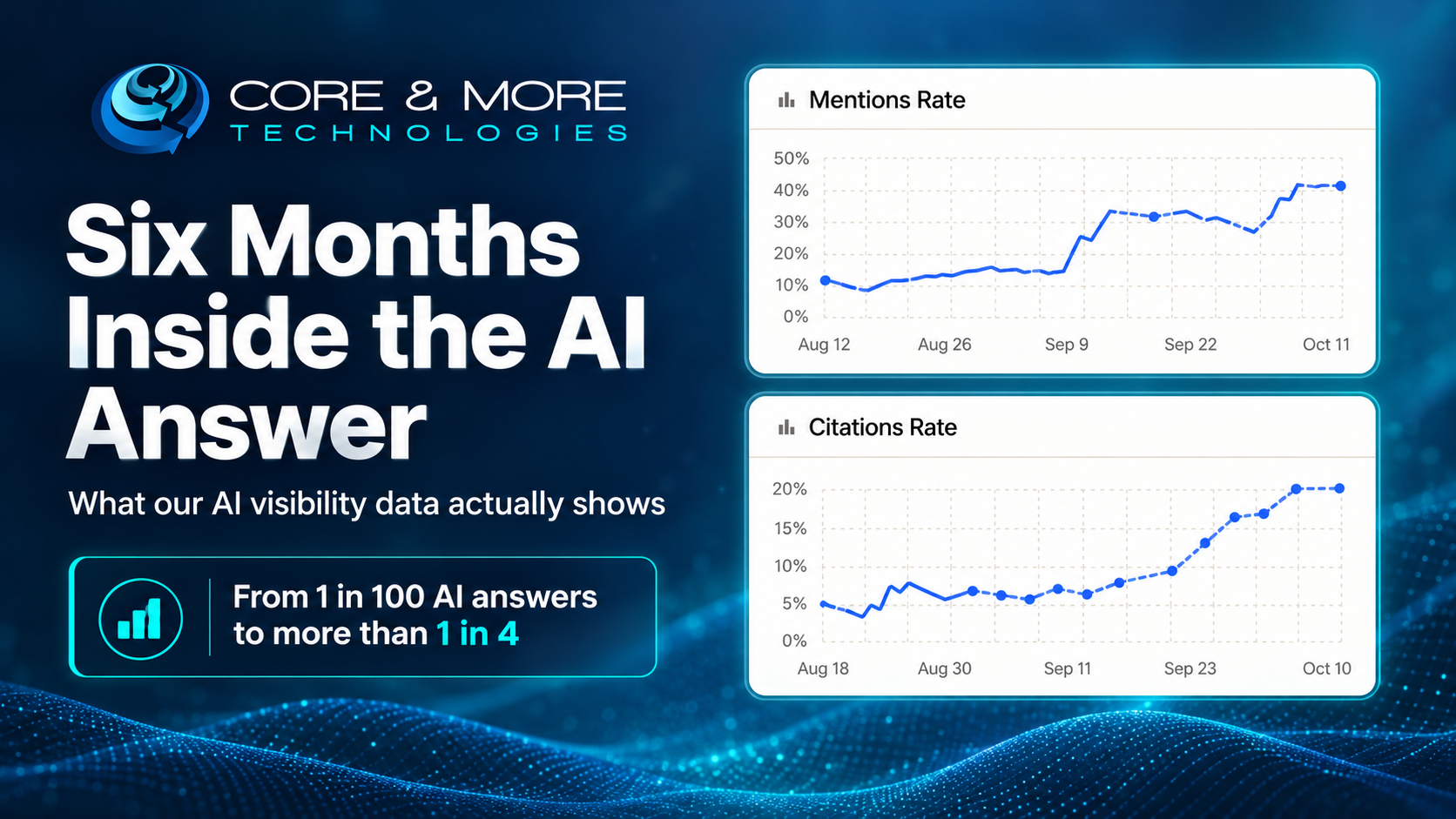
In April, AI engines named our energy procurement client in about 1 in 100 answers. By September, it was more than 1 in 4.
You may remember this client from July. They launched a brand-new website in a crowded B2B market, with no legacy authority to lean on. We built their Digital Growth Infrastructure from day one: technical SEO, entity structure, structured data, content architecture, and digital PR aimed at the third-party sources AI engines trust.
Here is the full trajectory, month by month.
| Month (2026) | Questions tracked | AI responses | Brand mentioned | Site cited | Competitors mentioned |
|---|---|---|---|---|---|
| April (site launch) | 10 | 92 | 1.1% | 0.0% | 8.7% |
| May | 10 | 92 | 10.9% | 4.3% | 17.4% |
| June | 10 | 98 | 15.3% | 17.3% | 18.4% |
| July | 10 | 97 | 20.6% | 29.9% | 22.7% |
| August | 46 | 581 | 21.9% | 21.5% | 23.6% |
| September | 46 | 428 | 27.8% | 29.7% | 26.9% |
| October (to Oct 11) | 46 | 165 | 29.1% | 26.7% | 24.8% |
Source: Scrunch AI monitoring across Google AI Overviews, AI Mode, ChatGPT, Gemini, Perplexity, Copilot, and Claude. “Mentioned” means named in the answer; “cited” means the brand’s own site was linked as a source. The teal line marks August, when tracking expanded from 10 questions to 46.
Three things stand out.
The brand earned a seat at the table, then pulled ahead. By September, AI engines mentioned our client in slightly more answers than they mentioned any tracked competitor. Six months earlier, the gap was eight to one the other way.
AI engines started citing the site, not just the name. Citation rate went from zero to roughly 30%. That means the AI is pointing users to the client’s own pages as the source of truth.
We made the test harder, and the numbers held. In August we expanded tracking from 10 questions to 46, many of them broader and more competitive. Visibility didn’t dilute. It kept climbing.
That last point matters most. A brand that only shows up for a handful of hand-picked questions has a trick. A brand that keeps showing up as the questions get broader has authority.
Case Study 2: Our Own Scorecard (Including the Part We Haven’t Won Yet)
We track ourselves with the same tools we use for clients. Since April, Core & More’s AI visibility has roughly tripled. We’re also still the underdog in our category.
We monitor 24 questions a prospective client might ask an AI engine about digital marketing agencies, AI search visibility, and growth infrastructure. Each month produces about 220 AI responses. The question set hasn’t changed, so the trend is apples to apples.
| Month (2026) | Core & More mentioned | Competitors mentioned |
|---|---|---|
| April | 4.0% | 85.8% |
| June | 9.2% | 81.7% |
| August | 9.7% | 86.0% |
| September | 12.6% | 76.2% |
| October (to Oct 11) | 12.0% | 74.7% |
Source: Scrunch AI monitoring, 24 fixed questions, about 220 AI responses per month.
Two honest readings of that table.
First, the trend is real. Our presence tripled on a fixed question set, and competitor share started to give ground in September.
Second, the agencies we track against still show up in three of every four answers. Credibility compounds. It doesn’t arrive overnight. We’d rather show you that than pretend otherwise.
The moment it became visible
On October 5th, I opened an incognito window and asked Google AI Mode a simple question: “please list good digital marketing companies in nj.” Core & More showed up in its “Best All-Around & Heavy Hitters” section. Another agency was listed above us, and we’re not going to crop that out.
What caught my attention wasn’t the placement. It was the description: “a steady force since 2010,” known for “strict transparency and zero hidden fees.” We didn’t write that. Google’s AI assembled it from what it found about us across the web: reviews, mentions, our history, and how consistently we show up.
One appearance isn’t a trend, and we don’t treat it like one. But it’s the qualitative side of the numbers above. You can’t prompt your way into that answer. You earn it over years, and then AI repeats it.

Why Credibility Is Winning: The Provenance Layer
Both case studies point to the same mechanism: AI engines are getting better at asking who said this, and can we trust them?
In our Beyond the Click newsletter, we called this the Provenance Inflection Point. As AI-generated content floods the web, the systems that summarize it need ways to separate credible sources from noise. Provenance is the broad category: authorship, metadata, verifiable sourcing, and, for some providers, watermarking technologies like Google’s SynthID.
The practical result for businesses is straightforward. Content volume is getting cheaper by the day, so it’s worth less as a signal. What stays scarce, and what AI engines lean on, is evidence that real experts stand behind your claims and that other credible sources agree.
That’s why our energy client’s visibility kept rising as we expanded the question set. Every third-party mention, every expert-authored page, every piece of clean structured data added another verifiable reason for an AI engine to include them. Those signals don’t expire. They accumulate.
Five Lessons From Six Months of Data
- Measure AI visibility before you try to improve it. You can’t manage what you can’t see. Start by tracking the questions your buyers actually ask AI engines, across multiple platforms.
- Track mentions and citations separately. Being named is good. Being cited as the source is better, because it sends the user to your site.
- Expect a curve, not a switch. Our energy client moved from 1% to 15% in the first two months, then kept compounding. Plan in quarters, not weeks.
- Invest in signals AI engines can verify. Third-party coverage, expert authorship, consistent entity data, and structured markup did more than content volume ever did.
- Be honest about where you stand. A brand that overstates its position is exactly what credibility-weighted systems are built to filter out. That goes for your marketing claims too.
So, Where Does Your Brand Stand?
Right now, someone is asking an AI engine a question your business should answer. Either your name comes up, or a competitor’s does.
Most businesses have no idea which. That’s the first thing we fix.
See where you stand: Our GlobalSphere™ AI Authority Index shows how AI engines see your brand today and what’s holding you back.
Talk to us: Request a consultation and we’ll walk you through your own numbers.
Stay current: Subscribe to Beyond the Click on LinkedIn.
Author Bio
Andrew Young is the CEO and founder of Core & More Technologies, a Google Partner since 2011. Andrew and his team engineer Digital Growth Infrastructure™ for established businesses, integrating SEO, paid media, AI visibility, conversion architecture, analytics, and automation into unified systems that compound over time. Core & More’s proprietary frameworks include GlobalSphere™, SourceCube™, and the AI Authority Index™.