

Bing Just Showed Site Owners Their AI Search Blind Spots. Google Hasn’t.
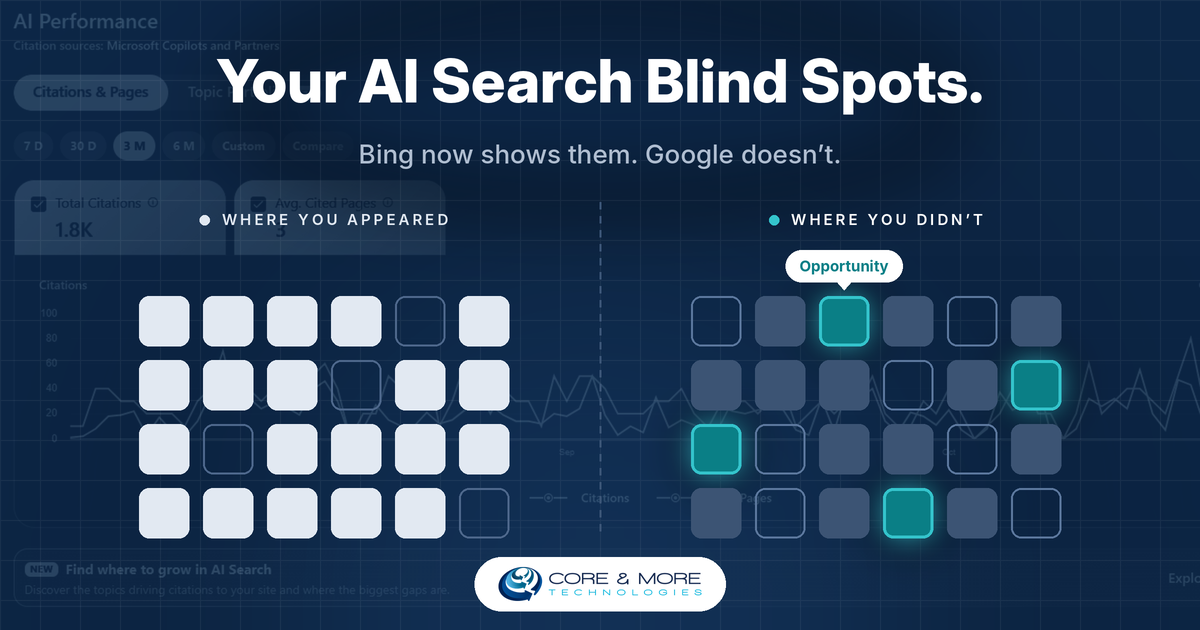
Google Shows You Where You Appeared. Bing Now Shows You Where You Didn’t.
On October 13, Microsoft added a beta feature called Topics Portfolio to the AI Performance report in Bing Webmaster Tools.
It does something no search engine had offered site owners before: it shows the questions where AI answers cite your competitors and not you.
That’s a bigger deal than it sounds. And it lands at an interesting moment for Bing, two years after we told readers that Google’s antitrust loss could open the door to other search engines.
Here’s what Topics Portfolio does, how it compares with what Google offers, and how our 2024 predictions held up.
What Topics Portfolio Shows
When Bing’s AI builds an answer in Copilot or Bing search, it runs its own searches behind the scenes to find sources. Bing calls these grounding queries. The AI Performance report, which entered public preview in February 2026, already showed which grounding queries cited your site and which of your pages were cited.
Topics Portfolio groups those queries into broad themes and adds context about the wider market for each one.
| What you see | What it tells you |
|---|---|
| Topic | A theme that groups related AI queries where your site appears |
| Topic Size | Approximate citations across all sites for that theme, a measure of how much AI demand it represents |
| Sites Cited | Approximate number of sites competing for citations in that theme |
| Queries | Approximate number of distinct AI queries in the theme |
| Opportunity Queries | Queries where other sites are cited and yours isn’t, with citation volume shown as a range |
Click into any topic and its queries split in two: the ones you already own, and the ones still open.
The opportunity list is the headline. Until now, AI visibility tools estimated gaps by running sample prompts through AI engines. We use those tools every day, and they’re valuable. But this is first-party data, from a search engine, about real AI answers. Coverage gaps used to be estimated. Now some of them can be measured.
The fine print
Microsoft is upfront that this is a beta. Topic labels are AI-generated and can be off. The numbers are approximate. Competitor brand names can show up as “opportunities.” And topics without enough data are hidden, so smaller sites may see a short list or no Topics tab at all. Treat it as a planning signal, not an accounting ledger.
How It Compares With Google
Google isn’t standing still. On June 3, 2026, it added Generative AI performance reports to Search Console, and they reached all sites worldwide by the end of August. They show impressions, pages, countries, and devices for AI Overviews and AI Mode, reported together.
That’s useful. But it answers a different question.
| Capability | Bing Webmaster Tools | Google Search Console |
|---|---|---|
| Dedicated AI visibility report | Yes | Yes |
| Your own AI visibility | Citations, grounding queries, cited pages | Impressions, pages, countries, devices |
| Grouped into topics | Yes (beta) | No |
| Demand and competition per topic | Yes (approximate) | No |
| Queries where competitors are cited and you aren’t | Yes | No |
Comparison as of October 25, 2026. Both platforms are updating these reports quickly.
In short: Google shows you where you showed up. Bing now shows you where you didn’t.
The Antitrust Backstory: Grading Our 2024 Call
In August 2024, right after Judge Amit Mehta ruled that Google had illegally maintained a monopoly in search, we published The State of Search in the Wake of Google’s Antitrust Trial Loss. Our advice was blunt: search is no longer synonymous with Google, so add Bing and other channels to your strategy now.
Two years and one remedies ruling later, here’s an honest scorecard.
What didn’t happen: a breakup. We flagged a breakup as the worst-case scenario. On September 2, 2025, Judge Mehta issued his remedies and rejected the government’s push to force a sale of Chrome. Google can still pay to be the default search engine, but those deals are now limited to one year, can’t require exclusivity, and Google must share some search index and interaction data with qualified competitors. The Justice Department and a coalition of states have appealed for stronger remedies, and Google is appealing the original ruling. The final shape of the market isn’t settled.
What did happen: Bing grew. According to StatCounter, Bing reached 5.29% of worldwide search in September 2026, its best month on record and up about 1.2 points from a year earlier. In the U.S., Bing is averaging about 9.5% of search in 2026, its strongest year since 2014. On desktop, its share is far higher than on mobile.
What we underestimated: AI. Our 2024 post talked about AI mostly through Google’s own experiments. The bigger shift turned out to be AI answers across every engine. Even Judge Mehta’s remedies opinion acknowledged that generative AI changed the course of the case.
One caution, because we hold ourselves to it: we’re not claiming the ruling caused Bing’s growth. The remedies are under appeal, and default deals still exist. Most observers credit Copilot and the Edge browser. But the two trends point the same way, toward a search market where Google is not the only engine worth measuring.
A note on the numbers: StatCounter measures referral traffic across a panel of websites, and monthly figures move around. The court record, based on 2020 data, put Bing at 5.5% of U.S. search queries. Read market share as a direction, not a precise count.
Why This Matters for Your Business
Bing feeds Microsoft’s AI. Bing’s index grounds the answers in Microsoft Copilot. Showing up well in Bing is part of showing up in AI.
Bing’s audience skews toward desktop. That matters for B2B brands whose buyers research from a work computer.
Gap data is a content roadmap. Opportunity Queries show, in your buyers’ own words, which questions AI engines are answering with someone else’s content.
What to Do This Week
- Verify your site in Bing Webmaster Tools. If you already use Google Search Console, you can import your sites from there.
- Open AI Performance and look for the Topics tab. If it isn’t there, your site may be below Bing’s data threshold for now. That’s a finding in itself.
- Start where you’re already cited. Begin with the topics where your citations are concentrated, then work through the opportunity queries.
- Filter the noise. Skip competitor brand names and topics that don’t fit your business, and use the thumbs-down feedback so Bing’s labels improve.
- Don’t stop at Bing. Topics Portfolio only sees Bing’s ecosystem. Pair it with monitoring across Google AI Overviews, AI Mode, ChatGPT, Gemini, and Perplexity for the full picture.
Frequently Asked Questions
What is Bing’s Topics Portfolio?
A beta feature in the AI Performance report in Bing Webmaster Tools, launched October 13, 2026. It groups the AI grounding queries where your site is cited into broad topics, estimates each topic’s demand and competition, and lists opportunity queries where other sites are cited and yours isn’t.
Does Google Search Console have anything similar?
Not yet. Since June 2026, Search Console has reported your impressions in AI Overviews and AI Mode by page, country, and device. As of October 2026, it doesn’t group AI visibility into topics or show queries where competitors are cited instead of you.
Can every site see Topics Portfolio?
No. Bing only shows topics with enough site presence and market activity, so smaller sites may see a short list or no Topics tab at all.
Did the Google antitrust case break up Google?
No. In September 2025, the court declined to order a sale of Chrome. Instead, it limited Google’s default search deals to one year, banned exclusivity requirements, and required some data sharing with qualified competitors. Both the government and Google are appealing.
Is Bing worth optimizing for in 2026?
For most businesses, yes. According to StatCounter, Bing reached a record 5.29% of worldwide search in September 2026 and is averaging about 9.5% of U.S. search this year. Its index also grounds Microsoft Copilot’s AI answers, and it now offers AI visibility data that Google’s tools don’t.
So, Where Does Your Brand Stand?
Right now, someone is asking an AI engine a question your business should answer. Either your name comes up, or a competitor’s does.
See where you stand: Our GlobalSphere™ AI Authority Index shows how AI engines see your brand today and what’s holding you back.
Talk to us: Request a consultation and we’ll walk you through your own numbers.
Stay current: Subscribe to Beyond the Click on LinkedIn.
Author Bio
Andrew Young is the CEO and founder of Core & More Technologies, a Google Partner since 2011. Andrew and his team engineer Digital Growth Infrastructure™ for established businesses, integrating SEO, paid media, AI visibility, conversion architecture, analytics, and automation into unified systems that compound over time. Core & More’s proprietary frameworks include GlobalSphere™, SourceCube™, and the AI Authority Index™.